Thinking Upstream About What’s Downstream
Why this year’s Secretary of Agriculture race is about far more than corn

I live near Charles City, in Floyd County, home to Iowa’s first whitewater park on the Cedar River. It draws kayakers, paddle boarders, tubers, and fishermen year-round and sits in the heart of downtown, free and open to the public. Each year, the whitewater park and related events bring thousands of visitors into the community, supporting local businesses and reinforcing the river’s role in our local economy.
In a state where more than 94 percent of the land is used for agriculture, public outdoor recreation is not abundant. Rivers and lakes offer something different. They are among the few spaces not defined by row crops.
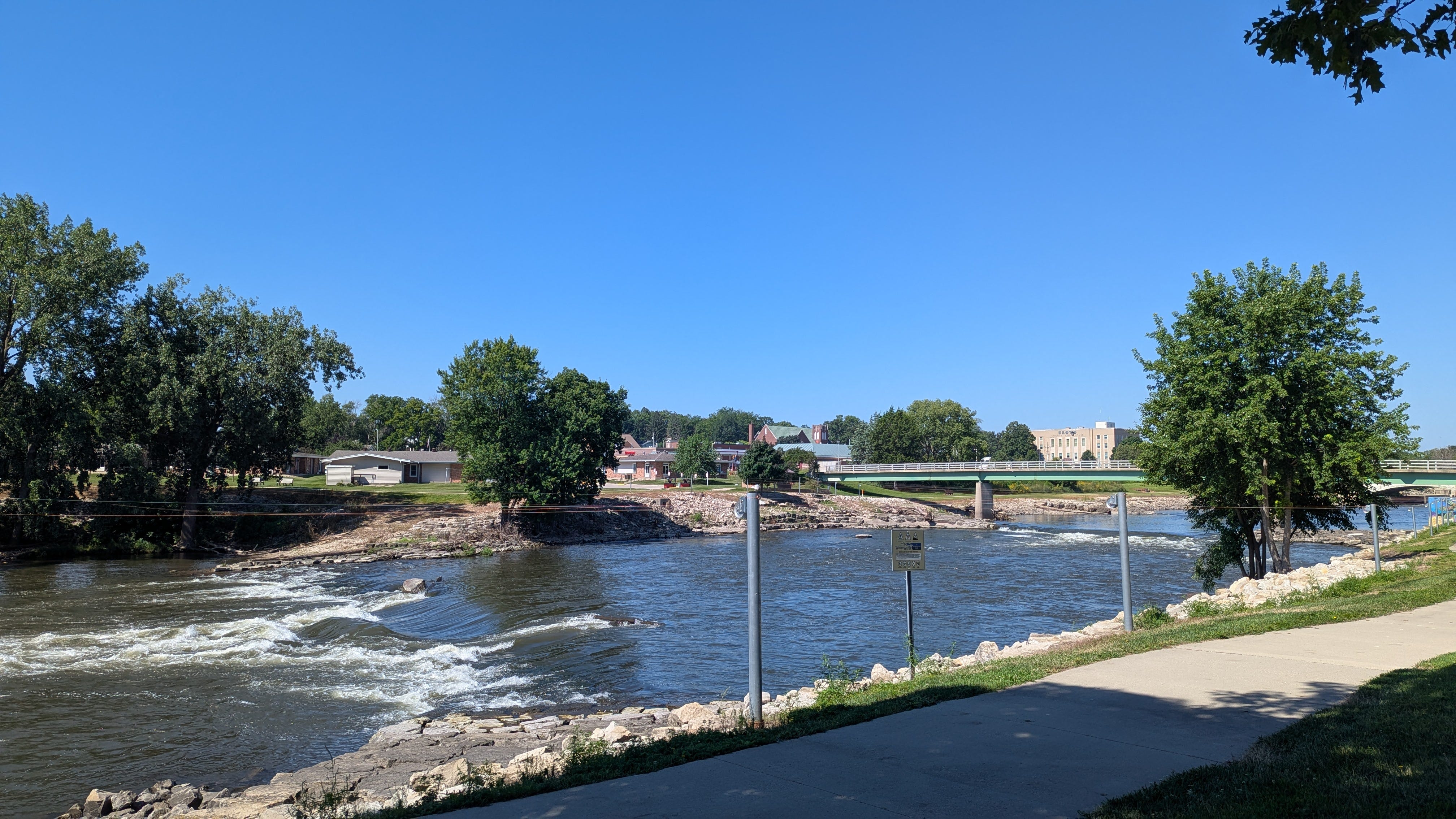
But Floyd County also sits squarely inside Iowa’s ethanol economy, within reach of major production facilities and part of the proposed carbon pipeline footprint. Corn and fuel markets shape much of the surrounding landscape. The systems that dominate that landscape do not stop at the riverbank. They drain into it.
In Iowa, water does not simply soak into the ground. Much of it moves through engineered tile drainage systems beneath corn and soybean fields, carrying with it whatever is soluble in the soil, including nitrate. That runoff contributes to impaired rivers and lakes that affect recreation, fishing, and public access, and it also flows downstream into municipal drinking water systems. Nitrate contamination remains one of the most persistent environmental and public health challenges facing the state.
For more than a decade, Iowa’s approach to water quality has relied on voluntary, incentive-based conservation. The state’s Nutrient Reduction Strategy emphasizes cost-share programs, technical assistance, and collaboration with farmers to reduce nutrient runoff. Billions of dollars have been directed toward these efforts, and that investment is frequently cited as evidence of progress.
Yet nitrate levels in many Iowa waterways remain largely unchanged. At the same time, Iowa continues to rank among the highest states in the nation for cancer incidence.
The numbers do not suggest success.
“Think downstream” is a common phrase in conservation work. It reminds farmers, businesses, and landowners that what leaves their land does not disappear. It ends up somewhere. It affects someone.
But downstream thinking has limits.
By the time water reaches a river intake or municipal treatment plant, the outcome has already been engineered by a landscape that grows mostly two crops. Corn and soybeans, reinforced by ethanol markets and concentrated livestock, shape what moves through tile lines and into rivers.
Those choices are upstream of the tap.
Long before water reaches a filter, it has already passed through the system we chose.
The Secretary of Agriculture does not control rainfall. But the office shapes the agricultural system that shapes our water. It influences which production models are promoted, how conservation is structured, and whether water quality is treated as a primary outcome or a secondary concern.
For decades, the office has aligned closely with industry promotion and voluntary conservation frameworks. Clean water has been acknowledged, but it has rarely been the standard by which leadership was judged.
Incumbent Secretary Mike Naig has defended that framework, emphasizing continued investment and collaboration as the appropriate path forward.
This year, that framework is being challenged.
Chris Jones, a water quality scientist, is running on a platform centered on measurable water quality outcomes and enforceable accountability. He argues that voluntary measures have not yielded measurable improvement and that clearer benchmarks are necessary.
This election cycle breaks from the usual script. For the first time in memory, a Secretary of Agriculture race is centered on whether Iowa’s water strategy is delivering measurable results.
That makes some in agricultural leadership uncomfortable. It should. If billions of dollars have been spent without measurable change, asking harder questions is not radical. It is responsible governance.
The fact that this race is explicitly about clean water signals a shift in the public conversation. Iowans are increasingly unwilling to separate agricultural policy from public health.
If that awareness deepens, it could redefine agricultural leadership in this state.
Iowa has extraordinary assets. Some of the most fertile soil in the world. Generations of agricultural knowledge. Farmers who understand land and weather in ways that cannot be taught in classrooms. A workforce capable of building and rebuilding systems.
The question is not whether we have potential. It is whether we have the cojones to align our policies with it.
If leadership centers clean water, measurable outcomes, and long-term stewardship, Iowa could look very different in a generation. A state that grows instead of slowly draining its own potential. A state young people choose to stay in, not one they quietly plan to leave. A state that feeds itself, not just global commodity markets.
That future is not guaranteed. But it is possible.
I know which direction I believe Iowa should move.
I know how I will be casting my vote.
Mallory DeVries is an Iowa-based writer and food system practitioner focused on how policy decisions shape food, water, and rural communities. She works in food systems communications, including with the Iowa Food System Coalition. This essay reflects her independent analysis and does not represent the positions of any organization.