No, Seriously. Some Rural Communities Want to Die.
How to kill a town in one easy vote.

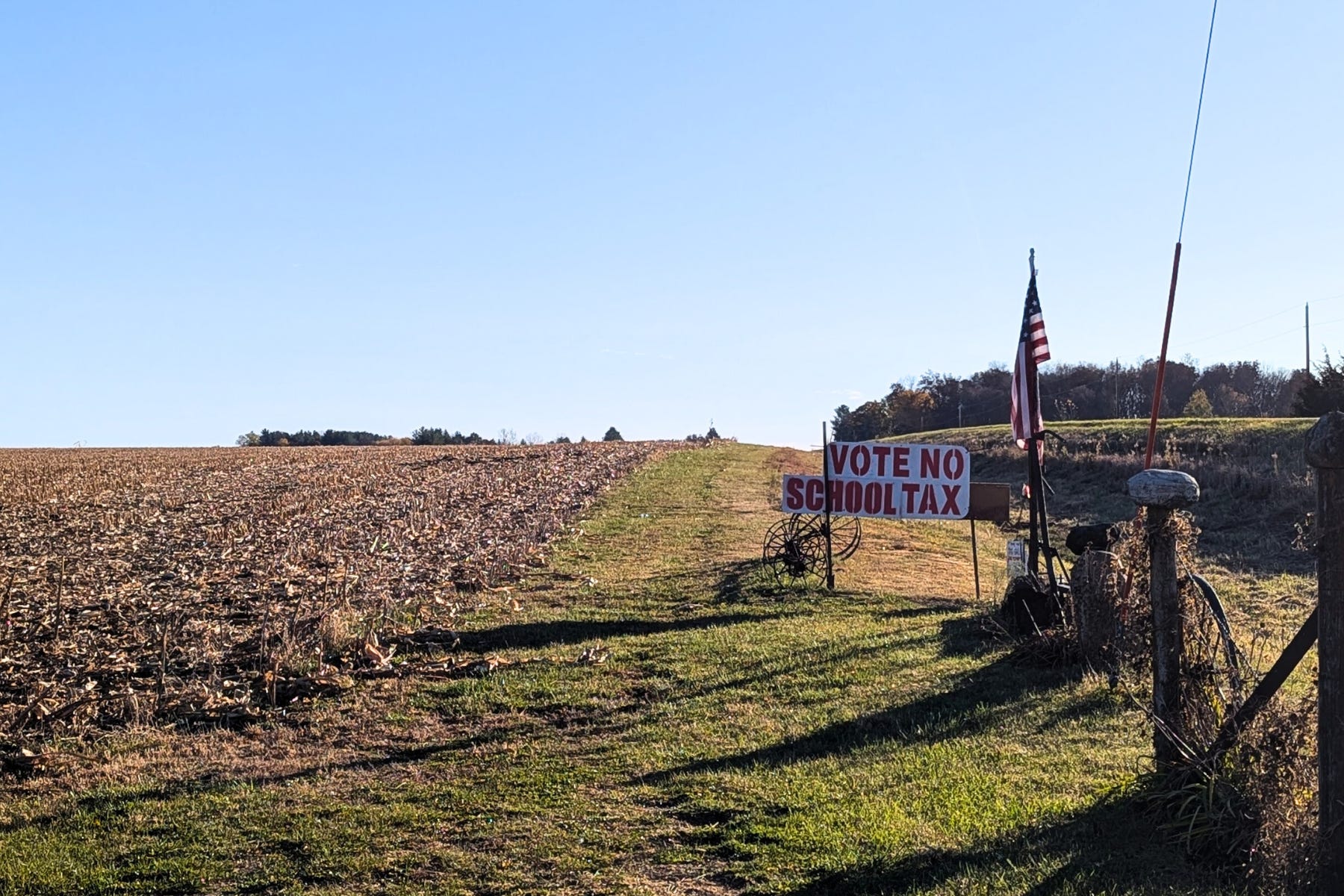
There’s a VOTE NO SCHOOL TAX sign still standing in front of a harvested cornfield on the edge of town. The crop’s been taken, the ground left bare. Just the sign and the stubble, one last monument to a season of taking.
On Tuesday night, the school bond vote failed. Again.
Thirty million dollars to fix the high school—gone.
Unofficial results: 47 percent yes, 53 percent no.
The Charles City High School was built in 1963 and has never been fully renovated. The bond would have funded basic safety updates: fire suppression, asbestos removal, air conditioning, and ADA compliance. Nothing flashy. Just safe, decent classrooms.
Some rural communities die slowly. Others pull the trigger themselves.
Charles City just chose the latter.
The high school is not safe. It’s not accessible. It’s not healthy. The asbestos isn’t buried in some corner of the building; it’s in the floors our kids walk on. The bathrooms are ancient and nowhere near ADA compliant. There’s no air conditioning, which means classrooms hit ninety degrees even in the dead of an Iowa winter. Teachers crack windows to breathe. Students get headaches by third period. Respiratory problems are routine. Fire suppression was an afterthought in 1963… and still is.
This isn’t a political debate. It’s a public health issue.
We moved back to Iowa in 2016, begrudgingly. Not to our hometown, but to a slightly larger community nearby. We wanted to raise our kids near family without returning to the same small towns we’d watched slowly hollow out. I thought this place might be different—maybe a little bigger, a little more forward-thinking. But last night, as the numbers came in, it felt like déjà vu.
My daughter, a bright little gal who uses a walker, will not be able to access parts of her own high school. Not because it’s under construction, but because the community she’s growing up in decided it wasn’t worth fixing—for a 0.27 percent property tax increase.
And my son, who advanced a grade level this year and is still performing at the top of his class, will never reach his full potential in a building that’s falling apart. His teachers are wonderful and doing everything they can with what they’ve got. But there’s only so much anyone can do inside a system that refuses to invest in itself.
So yes, we’ll be leaving before our kids get to that building.
When the governor brags about cutting state taxes, everyone cheers like they just won the lottery. But the need for funding doesn’t disappear; it just gets pushed down the line. Roads still need fixing. Schools still need heat. Someone still has to pay the light bill.
So what happens? Local governments are left holding the bag. Counties, cities, school districts (the people closest to the actual work) have to raise their own taxes just to keep up. Then everyone throws a fit about “big government,” while the big government that caused the problem walks away clean.
It’s political sleight of hand, and rural communities fall for it every time. I call it rural rage. The kind that burns hottest at the mention of taxes or government, but never seems to spark when kids can’t breathe in their classrooms.
We’ve been sold this idea that low taxes equal freedom. But it’s really neglect dressed up as virtue. A slow starvation of the public good. The state cuts funding, the locals say no, and before long, the schools crumble, the hospitals close, and the young families pack up and leave.
And then we all stand around wondering what happened to the town we loved.
Funny thing, though—our little hometown district that we didn’t want to return to, North Butler, passed their own levy last night. A smaller place, with fewer people and fewer resources. They said yes. They chose investment. They chose the future.
I’m proud of them.
I keep thinking about the VOTE NO sign in front of the empty cornfield. The harvest is over, the ground stripped bare, nothing left but residue. It feels like a metaphor we didn’t mean to write.
Because that’s what this vote was: a harvest. Of fear. Of resentment. Of short-term thinking that trades tomorrow for today.
You can’t build a future on extraction. Not from the land. Not from your people. Not from the children sitting in sweltering classrooms breathing in asbestos dust while adults congratulate themselves for keeping taxes low.
This town could have chosen repair. It could have chosen accessibility, safety, decency. Instead, it chose decline and called it fiscal responsibility.
I still believe in rural Iowa. I believe in what it could be if it remembered what community actually means. But belief isn’t enough. It takes investment. It takes courage. It takes saying yes.
The irony is that the people with the most power to save these towns often feel the least connected to them. Most of the land around here is owned by farmers who don’t live in town. Their businesses depend on global markets, not local ones. Corn goes to ethanol plants and feedlots, not the school cafeteria (can you imagine what it would be like if it did!?). When the price of soybeans dips in China, it hits harder than any bond issue ever could.
So when a vote like this comes up, they see it as someone else’s problem. The bond taxes ag land a little higher, sure, but the payoff feels distant. If you don’t have kids in school, why bother?
But that’s the point. The kids are the future of this community. Not the rows of corn. Not the yield reports. Not the commodity checks. I’m not blaming farmers. I’m blaming the broken system that tells them survival means saying no.
A school isn’t just a building. It’s the heartbeat of a town. When we stop investing in it, we’re not saving money. We’re draining the life out of the very places we claim to love.
Some rural communities die slowly. Others pull the trigger themselves.
That’s not decline. That’s death by refusal to chip in.
Interesting- different town and state but similar issues. Out in the far west, in a ranching community where the population is aging, the only people moving in are retirees from other west coast states hoping to spend their golden years on their little 1-5 acre “ ranch “. Have raised the housing prices and priced out families, cut taxes and voted in a far right school board that hired an incompetent far right lawyer who stole millions from the school district. Any taxes or school bonds fail, the school population has decreased significantly and with the loss of millions from the corrupt school board, the state now has to come in and take over the school district’s finances. This was once the highest ranking school district in the state, it was rural but prided itself on being innovative and paying well but within a decade it’s completely collapsed.
The selfishness of the older retirees can not be overstated.
They have come in and completely destroyed the small town charm that attracted them to this area, by refusing to pay taxes, voting in extremists and jacking up housing with their money.
My memory of Charles City is from about 20 years ago. I was driving through and had stopped to get gas. I accidentally locked my toddler in my car, and immediately realizing this, called the police in town. And they told me, “We don’t do that anymore.”
They don’t help parents get their babies out of locked cars “anymore.” Like it’s a thing they used to do, but don’t.
So I had to call a locksmith.
I don’t have a lot of respect for Charles City. I’m sorry that Charles City doesn’t care about its own children, either.