If Iowa Had to Feed Itself
A thought experiment about closed Iowa borders and the missing middle of the food system.

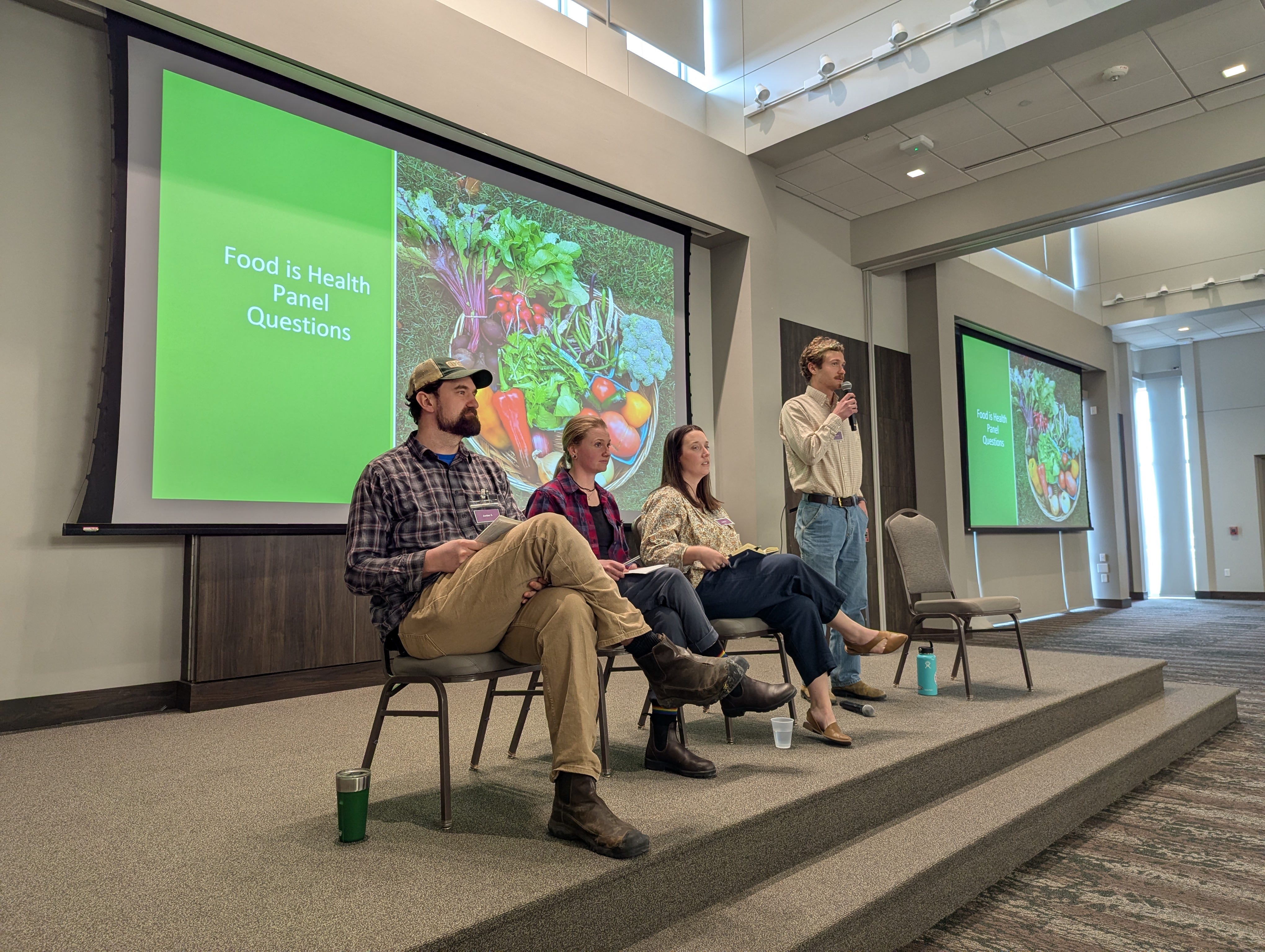
Earlier this month I spent two days at the Healing from the Ground Up Summit, listening to farmers, dietitians, soil scientists, and public health leaders talk about the connections between soil health, human health, and the future of our food system.
One of the themes that kept surfacing was how deeply interconnected everything is. Soil becomes crops. Crops become food. And food becomes health.
“What’s in the soil becomes what’s in the food,” one speaker said.
It’s simple enough that it almost sounds obvious.
If soil shapes what we grow, and what we grow shapes what we eat, it raises a question we rarely ask out loud: what if Iowa actually had to feed itself?
Let’s do a little thought experiment. Our borders close tomorrow. Nothing comes in. Nothing goes out. No food shipments crossing state lines, no ingredients arriving from somewhere else, no trucks carrying Iowa commodities to distant markets.
Just us, and whatever we can grow, raise, process, and distribute within the state.
What would we actually eat?
What Would Be Left on the Plate?
Obviously, the global pantry items disappear pretty quickly. Coffee. Bananas. Citrus. Chocolate. Olive oil. Most spices.
But some of the losses might surprise us too. Peppers. Tomatoes. Strawberries. Spinach. Foods that show up in Iowa grocery stores year-round, but spend much of that year traveling thousands of miles to get there.
The US now imports more than half of the fresh fruit we eat and a growing share of our vegetables. Global supply chains quietly fill our kitchens in ways we rarely notice until they stop.
Let’s start with breakfast.
Eggs are doable. Milk too. Maybe some bacon on the side, though even that comes with a caveat. Iowa raises a staggering number of hogs, but most of that pork moves through large processing systems and national distribution chains. A lot of it leaves the state before making its way back to grocery store shelves. Borders are closed, remember.
Still, for the sake of the thought experiment, let’s assume we can keep some of it here.
But the coffee is gone. Which, depending on the morning, may be the real crisis.
Lunch might look like a ham sandwich, maybe some sweet corn in the summer. Apples in the fall if we’re lucky.
But the bread gets tricky.
Iowa grows plenty of corn and soybeans, but very little wheat or oats. The flour that fills most of our bakeries and grocery store shelves comes from somewhere else. Without those outside supply chains, the breadbasket of the Midwest starts looking a little… light on bread.
Seafood is also off the menu. (Iowa has many wonderful qualities, but a coastline is not one of them.)
Dinner could be pork again. Or beef. Maybe potatoes. Maybe some squash. In Iowa terms, this is where casseroles start showing up in force.
At first glance, that doesn’t sound too bad. Iowa produces a lot of meat, eggs, and dairy. But there’s a catch: the vast majority of that food moves through supply chains designed for national and global markets, not for feeding three million Iowans directly.
Take eggs. Iowa produces billions of them each year, but most come from large facilities designed to ship into national distribution networks. Pork and beef move through similar systems, often leaving the state for processing before finding their way back onto grocery shelves.
If those systems suddenly stopped moving across state lines, even foods that seem abundant could start to feel scarce.
This is where the thought experiment runs into something food system folks call the missing middle.
The Missing Middle
For decades, agriculture policy has favored scale and efficiency. Small processors disappeared. Regional distributors consolidated. Infrastructure that once connected farms to nearby markets vanished.
The missing middle isn’t just a metaphor. It’s the physical systems that used to sit between farms and eaters: small meat lockers, grain mills, vegetable packing houses, regional distributors, refrigerated trucks, cold storage facilities, and the workers who keep those systems running.
What’s left is a system that can move enormous quantities of commodity crops across oceans, but cannot move food from a nearby farm to a nearby school cafeteria.
Which brings us to something happening in Iowa right now.
When Policy Follows Production
The Iowa House recently passed a wide-ranging health policy bill, often referred to as the governor’s “MAHA” bill, that includes a provision directing the state to request a federal waiver allowing Iowa to create its own school meal standards rather than following federal nutrition guidelines.
(An interesting moment to pursue independence, honestly, given that the federal conversation around nutrition standards seems to be drifting in a similar direction anyway.)
Supporters frame the proposal as an opportunity to design meal standards that better reflect Iowa agriculture.
Critics worry the proposal could deepen the grip commodity agriculture already has on state policy. The bill directs the state to prioritize foods in the order of “animal protein, dairy, vegetables, and fruit,” placing Iowa’s dominant livestock sectors at the top.
If standards are designed to reflect Iowa agriculture, they will largely reflect the crops and livestock Iowa already produces.
The problem is that Iowa agriculture doesn’t neatly line up with what a balanced school meal actually requires. We produce enormous volumes of meat, eggs, and dairy, but relatively few vegetables, and the regional supply chains needed to move them into school kitchens barely exist.
In other words, letting production shape nutrition policy rather than the other way around.
At the summit, one panelist talked about the idea of “market-first farming.” Beginning farmers are often encouraged to start there: figure out what people in your community want to eat, and grow that.
That’s almost the opposite of how Iowa agriculture has evolved at scale. We grow what global commodity markets reward, and then try to build the rest of the food system around it. Sometimes we grow so much of it that the market collapses under its own weight.
Which means that even if Iowa rewrites its nutrition standards, much of the food served in school cafeterias will still travel through the same national distribution networks it does today.
I shouldn’t have to say this, but kids still need vegetables. Apparently that’s a policy debate now.


Built for Markets, Not Meals
That’s the strange irony at the heart of Iowa agriculture.
We grow enormous volumes of agricultural commodities. We feed livestock, fuel cars, and supply ingredients to global markets.
But if you sit down and try to plan three simple meals using food that truly moves through Iowa farms, Iowa processors, and Iowa supply chains, the options start to narrow surprisingly quickly.
And yes, farmers markets exist. In the middle of summer they can be overflowing with tomatoes, greens, sweet corn, and berries, but they were never designed to feed three million people three meals a day. If every Iowan suddenly showed up trying to fill a week’s worth of groceries, elbows would be thrown.
This isn’t a failure of farmers. Iowa farmers are among the most productive in the world. It’s the result of decades of policy decisions that built a system designed to move bulk commodities efficiently, not necessarily to nourish nearby communities.
Which is why conversations about soil health, nutrition, and food systems keep circling back to the soil itself. What we grow in it, and what we put into it, ultimately shapes the entire food system built on top of it.
If what’s in the soil becomes what’s in the food, it’s worth asking whether the system we’ve built was ever designed to feed us at all.

Mallory DeVries is an Iowa-based writer and food system practitioner focused on how policy decisions shape food, water, and rural communities. She works in food systems communications, including with the Iowa Food System Coalition. This essay reflects her independent analysis and does not represent the positions of any organization.
The fallacy of bucolic family farms and “Iowa Nice,” is thankfully finally being challenged. We’re a multi national excavation site, much like strip coal mining states where toxic waste and residue is considered the norm, the cost of doing business.
Once, the proud example of civil liberties and unalienable rights, we’ve become a pariah of discrimination and bigotry. We’re nice enough but only if you pass the profile test of race, religion, gender and partisanship.
I'm writing a piece about the summit as well!!